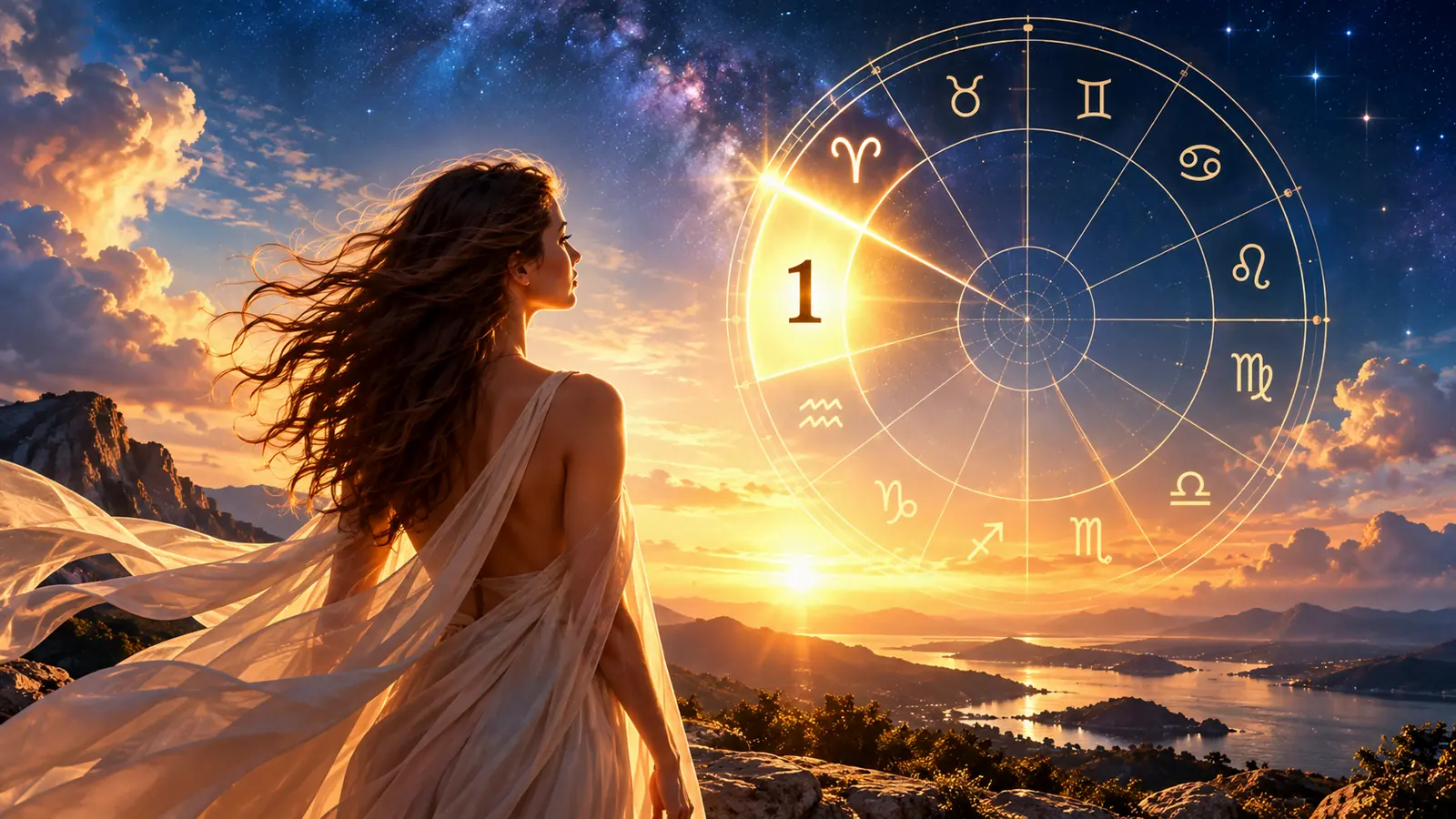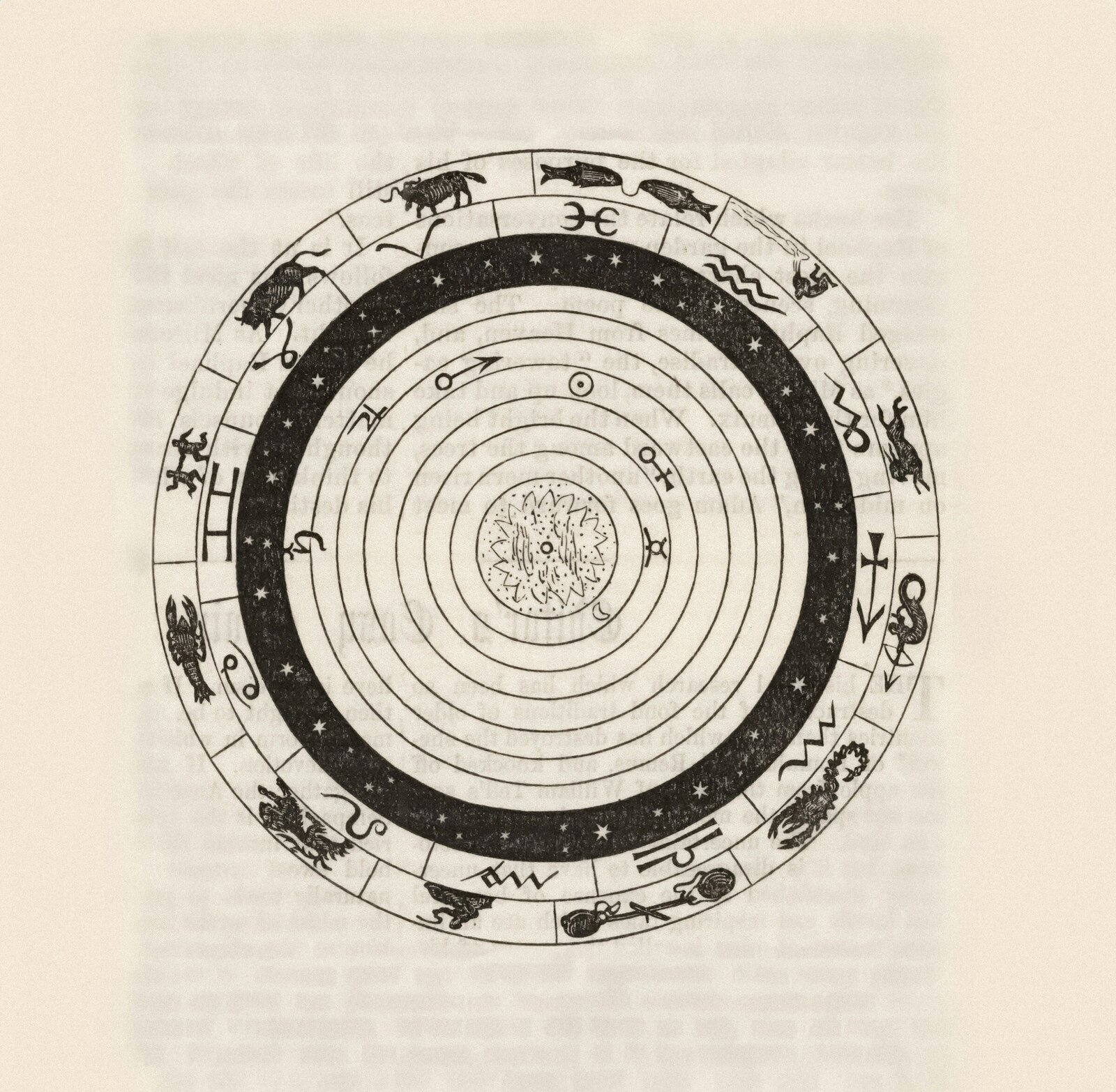
A birth chart is a drawing of the sky as it looked at the moment and place you were born. It shows where the Sun, the Moon and the planets stood at that minute, all in one circle.
When you say "I'm a Leo," you're naming a single point in that chart: the sign the Sun was in on your birthday. The chart records the rest of the moment too. Where the Moon was, which sign was coming up over the eastern horizon, and what angles the planets were making to one another.
What does a chart record?
Seen from Earth, the Sun seems to follow the same path across the sky every year. That path is called the ecliptic. The Moon and the planets travel close to it. Western astrology splits the ecliptic into twelve slices of 30 degrees each, starting from the spring equinox. Those slices are the signs.
A birth chart notes which slice each body was in, and at which degree, at the minute you were born. This part is calculation, not interpretation. Planetary positions can be worked out with high precision for centuries in either direction. Zodivia's charts are calculated with the Swiss Ephemeris, which is built on NASA JPL data.
The signs aren't the same thing as the constellations. They borrowed their names, but a slow wobble in Earth's axis has pulled the two apart over the centuries. When astrology says "Aries," it means that 30-degree slice of the ecliptic, not the stars behind it.
Why does birth time matter so much?
The Sun spends about a month in each sign, which is why people born in the same month usually share a sun sign. The Moon is much quicker. It covers around 13 degrees a day and stays in a sign for about two and a half days, so two people born in the same week can have different Moon signs.
Quickest of all is the rising sign: the sign coming up over the eastern horizon at the moment you were born. Because Earth spins, the rising sign changes on average every two hours. The twelve houses are laid out from the rising sign, so a few minutes' difference in birth time can move their boundaries.
That's why an accurate chart needs three things: date, time and place. If you don't know your time, Zodivia still draws your chart. The planets' signs are calculated, but the rising sign, the MC and the houses are left out entirely, because without a time they'd be no more than guesses. If you want to track your time down, a birth certificate, a hospital record or an older relative is a good place to start.
The four layers of the circle
The circle that looks so busy at first is made of four things:
- Planets. The Sun, Moon, Mercury, Venus, Mars, Jupiter, Saturn, Uranus, Neptune and Pluto. Astronomy doesn't count the Sun and Moon as planets; astrology groups them in by tradition. Each is linked to a theme: Mercury to communication, Venus to love and taste, Mars to taking action.
- Signs. The tone a planet is expressed in. The same Mars reads differently in Aries than in Pisces.
- Houses. The chart's twelve sections, each tied to an area of life: body and personality, money, relationships, work.
- Aspects. The angular distances between planets. The main ones are the conjunction (0°), sextile (60°), square (90°), trine (120°) and opposition (180°). Traditionally, trines and sextiles count as easy, squares and oppositions as challenging.
Where should you start?
If you're new to this, start with the Sun, the Moon and the rising sign, often called the Big Three. Tradition links the Sun sign with identity and direction, the Moon sign with feelings and needs, and the rising sign with how you come across and how you meet the world. Plenty of people who feel nothing like their sun sign recognise themselves more once they look at their Moon or rising sign.
Why does the same chart look different on different sites?
Planetary positions are the same everywhere. The difference nearly always comes from the house system. There's no single way to divide the houses: Whole Sign, Placidus, Koch and Equal House are a few of the methods that grew up over the centuries. If a planet is in the 10th house on one site and the 9th on another, the house systems are most likely different.
Zodivia uses Whole Sign by default. Under "Advanced settings" in the form you can switch to Placidus, Koch, Equal House, Porphyry, Regiomontanus or Campanus.
What a chart can't tell you
The positions in a chart are measurable facts. The meanings attached to them come from a symbolic tradition thousands of years old. Scientific studies haven't shown that astrology predicts personality or events. For many people that was never the point. A chart's value lies in giving you a frame for thinking about yourself and looking at your life from another angle.
Using that frame well mostly comes down to a few things. A challenging aspect doesn't mean a hard life, and an easy one doesn't promise smooth sailing. Your character is shaped by where you grew up, what you've been through and the choices you make. On health, money, legal or mental-health decisions, a chart is no substitute for a professional. And judging a person or a relationship by a chart alone isn't fair to anyone.
Draw your own chart
Enter your date, time and city of birth and Zodivia's birth chart tool will draw your chart in a few seconds. No sign-up needed. If you only want your rising sign, the rising sign calculator is the shorter route.
Once your chart is open, look at the Big Three first and ask yourself: which of these three descriptions feels closest to me, and which one doesn't sound like me at all?