You read a birth chart by asking four questions: which planet, in which sign, in which house, and making which aspects. The planet tells you what's involved, the sign how it's expressed, the house where in life it shows up, and the aspects how it interacts with the rest of the chart.
Put those four answers together and you have one sentence about one placement. Reading a chart means building those sentences one at a time, then looking at how they connect.
Check the inputs first
Before you interpret anything, make sure the chart was drawn from the right data. The top of the results page shows your birth date, time and city, with the UTC offset in effect at that moment next to the time. Daylight saving rules have changed many times in many countries. If your birth time was read in the wrong time zone, your rising sign can change completely, so that line is worth a glance.
How to find your way around the wheel
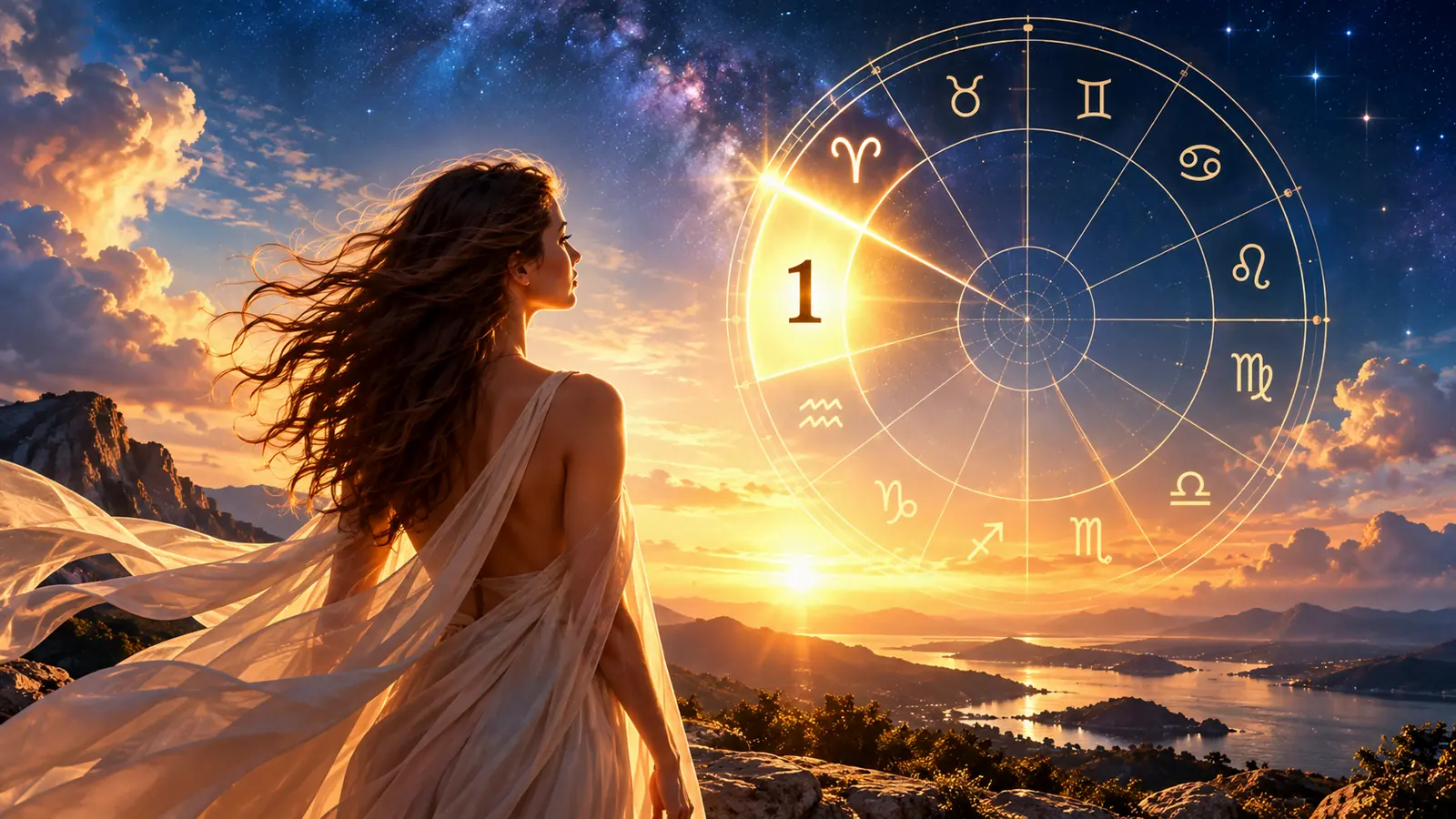
The left side of the wheel is the eastern horizon. The rising sign, the sign coming up in the east when you were born, sits there. The houses are counted from that point, anticlockwise. The 1st house is on the left around the rising sign, and the 7th is directly opposite on the right. The point near the top is the MC. The top half of the wheel is the sky that was above the horizon when you were born, the bottom half the sky below it.
If the wheel is hard to follow, switch to the table. On Zodivia, the sign, degree and house of every point are also listed in the positions table below the wheel.
Reading it step by step
- Start with the Big Three. The Sun, the Moon and the rising sign are the most-read points in any chart. Note down their signs.
- Look at each planet's sign. The planet answers "what," the sign answers "how."
- Look at each planet's house. The house answers "in which part of life."
- Look at the aspects. Which planets are talking to each other, and is the conversation easy or tense?
- Build the sentence. Combine the four answers, then compare it with the other placements.
What do the planets stand for?
Tradition ties each planet to a theme:
- Sun: identity, vitality, direction
- Moon: feelings, needs, habits
- Mercury: thinking, speaking, learning
- Venus: love, taste, what you value
- Mars: desire, action, anger
- Jupiter: growth, optimism, the search for meaning
- Saturn: responsibility, limits, maturity that comes with time
- Uranus, Neptune and Pluto: change, imagination, transformation
Those last three move very slowly. Pluto can spend more than a decade in one sign, so everyone in a generation shares the same sign for it, and in a personal reading the useful information comes from their houses and aspects. Zodivia's chart also shows the Lunar Node, Chiron and Lilith. If you're just starting out, you can leave those for later.
Which area of life does each house cover?
- 1st house: body, personality, approach to life
- 2nd house: money, possessions, resources
- 3rd house: communication, siblings, your neighbourhood, learning
- 4th house: home, family, roots
- 5th house: creativity, fun, romance, children
- 6th house: daily work, routines, looking after yourself
- 7th house: relationships, partnerships, marriage
- 8th house: shared resources, inheritance, transformation
- 9th house: long-distance travel, beliefs, higher education
- 10th house: career, reputation, your place in public life
- 11th house: friends, groups, hopes
- 12th house: retreat, time alone, what stays out of sight
Empty houses are normal. With ten planets spread across twelve houses, every chart has at least two empty ones. An empty house doesn't mean that area is missing from your life. Instead you look at the ruler of the sign on that house. If your 7th house is in Libra and has no planets in it, for example, the story of that house is carried by Venus, Libra's ruler, wherever it sits in your chart.
How to read the aspects
An aspect is the distance in degrees between two planets. They don't have to be exactly 90 degrees apart to form a square. A few degrees of leeway is allowed, and that leeway is called the orb. Zodivia uses an orb of 8 degrees for conjunctions, trines and oppositions, 7 for squares and 6 for sextiles.
The tighter the orb, the stronger the aspect is read. Zodivia sorts the aspects from the tightest orb to the widest, so the ones at the top of the list are the chart's loudest themes. When you see a square or an opposition, don't treat it as a problem. Think of it as a place where two themes push against each other and, often enough, get each other moving.
An example
Say your chart has Venus in Gemini, in the 5th house, square Saturn. The pieces fit together like this.
Venus is linked to love and taste. Gemini expresses that through curiosity, words and variety. The 5th house takes the theme into fun, flirting and creativity. The square to Saturn adds some seriousness or caution to that area. In a traditional reading, this might describe someone who shows affection by talking and playing, but who sometimes holds back from fully letting go.
That sentence is a question, not a verdict. You ask yourself, "Does this fit me?" If it doesn't, something elsewhere in the chart may be balancing it out.
Common mistakes
The most common one is reading each placement on its own and getting stuck on contradictions. If your Moon in Cancer describes someone inward-looking and your Mars in Aries someone bold, both can be true. People don't fit into one sentence, and neither do charts.
Another is reading challenging aspects as bad news. Tradition calls a square "challenging," but that doesn't mean something bad will happen. And people often forget about house systems. If another site puts a planet in a different house, first check whether both sites use the same system. Zodivia uses Whole Sign by default.
The positions in a chart are calculated and exact. The meanings given to them come from a symbolic tradition, not from scientifically proven predictions. A chart is most useful as a way to ask yourself questions.
If you don't know your birth time
Without a time, Zodivia doesn't calculate the rising sign, the MC or the houses. You can still read the planets' signs and the aspects between them. Be a little careful with the Moon: it moves about 13 degrees a day, so if it changed sign on the day you were born, your Moon sign may be uncertain too.
Try it now
Draw your birth chart and pick a single planet. Write down its sign, its house and the first aspect it makes in the list, then turn them into one sentence. The rest of the chart is read the same way.