The North Node is the point where the Moon's orbit crosses the Sun's yearly path heading north. It isn't a body in the sky but a calculated point. In modern astrology it stands for your direction of growth: the side of life that feels unfamiliar but does you good.
The planets in your chart are real objects; look up and you can see them. The lunar nodes are invisible. They mark the place where two orbits cross. Even so, astrology has read them for thousands of years, because eclipses always happen close to them.
What exactly is a lunar node?
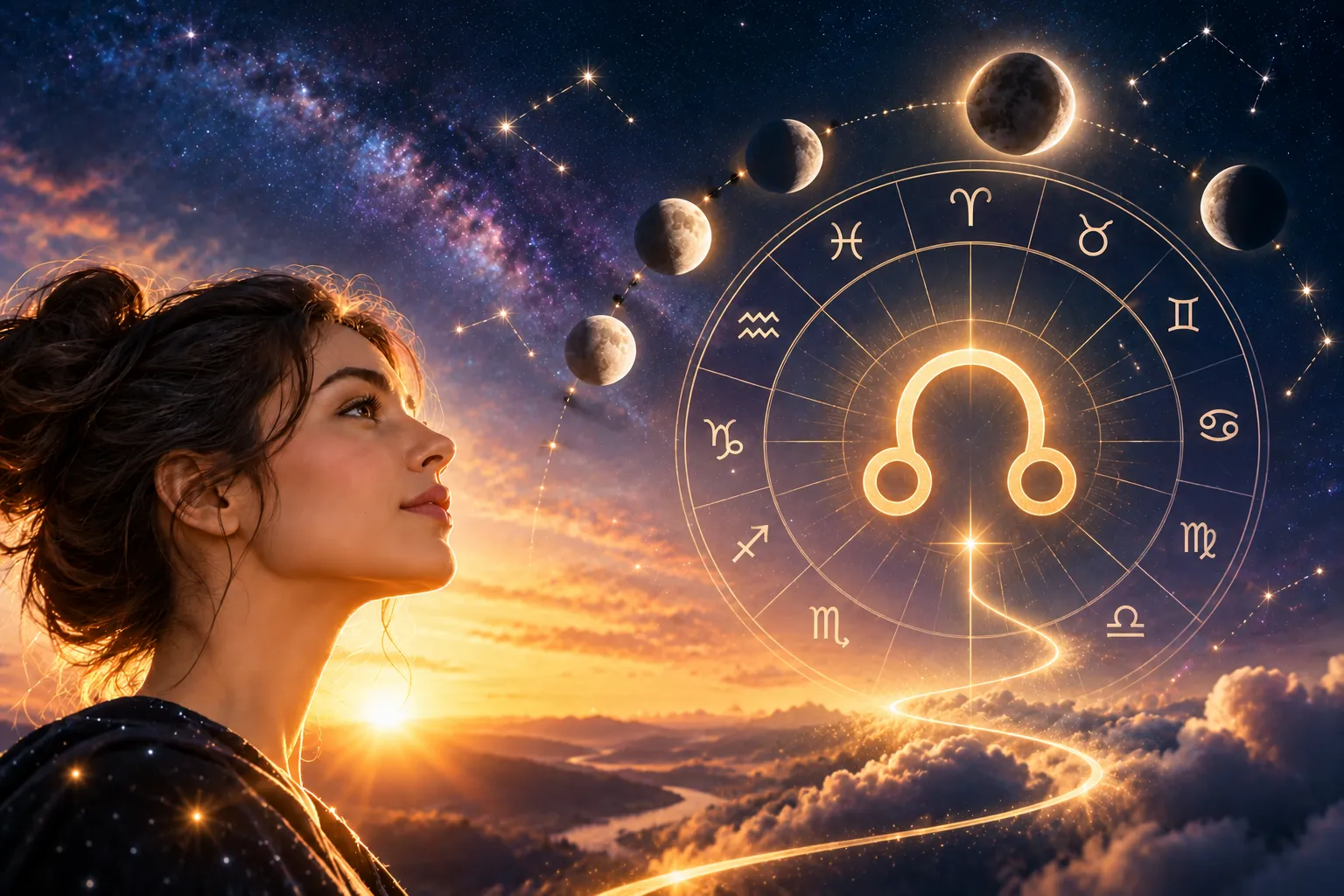
The Sun's yearly path across the sky is called the ecliptic. The Moon's path doesn't line up with it exactly; it's tilted by about 5 degrees. So on each circuit, the Moon crosses the ecliptic at two points. The point where it crosses heading south is the South Node, and the point where it crosses heading north is the North Node. The two are always exactly opposite each other, 180 degrees apart.
When a new moon or full moon happens near one of these points, the Sun, Moon and Earth line up and there's an eclipse. That's why eclipse seasons come twice a year, six months apart.
How do the nodes move?
The lunar nodes move backwards through the signs and take about 18.6 years to go all the way round. They spend around a year and a half in each sign on average. So you don't need a birth time to know your node's sign, but you do need one to know its house.
There are two ways of calculating them. The mean node is a smoothed-out version of this motion. The true node is based on the Moon's actual orbit at that moment and can differ from the mean by a degree or two. Zodivia uses the true node. The point shown with the ☊ symbol and labelled "True Node" on the results page is the North Node.
The South Node isn't listed separately, because its position is fixed: it's in the sign directly opposite the North Node, at the same degree. If your North Node is at 12° Aries, your South Node is at 12° Libra.
The nodes in tradition
Medieval astrology called the North Node the "dragon's head" and the South Node the "dragon's tail." The image of a dragon swallowing the Sun or Moon during an eclipse comes from here. In Indian astrology the same points are read as Rahu and Ketu. In the classical view, the North Node was seen as a point that increases and the South Node as one that diminishes.
Modern astrology, especially the psychological approach that grew up in the 20th century, reads the nodes as an axis. The South Node stands for what comes easily, feels familiar and lets you stay comfortable. The North Node stands for the direction that feels foreign but feeds you as you grow into it. Some sources describe this in terms of a "soul mission," "karma" or "past lives." That's a belief, not something measured or demonstrated.
What does the nodal axis describe?
Because the nodes always sit in two opposite signs, there are six possible axes. In modern readings, growth is read as moving toward the North Node's side:
- Aries and Libra: standing on your own and being with someone.
- Taurus and Scorpio: holding on and sharing, letting things change.
- Gemini and Sagittarius: the details and the big picture.
- Cancer and Capricorn: home and family, and the outside world and responsibility.
- Leo and Aquarius: personal expression and community.
- Virgo and Pisces: order and control, and letting go.
If your North Node is in Libra and your South Node in Aries, a modern reading sees you as someone used to making decisions alone who learns to cooperate over time. The other way round, as someone used to fitting in who's moving toward finding their own voice.
The houses the nodes fall in are read the same way. With the North Node in the 10th house and the South Node in the 4th, tradition reads growth as moving out of the safe space of family and toward taking on a role in public life.
The nodal return
Every 18.6 years, the nodes come back to the positions they held in your birth chart: around ages 18 or 19, 37 and 56. These dates can be calculated exactly. Some astrologers interpret them as times when you rethink the direction of your life.
The node isn't destiny
The North Node is often described as "your destiny" or "your life purpose." That language promises something a chart can't show. Astrology hasn't been shown scientifically to predict the course of someone's life. The nodal axis works best as a question: outside your comfort zone, what might help you grow?
Look at your own nodes
Draw your birth chart and find the sign and house of the "True Node" in the positions table. Your South Node is in the opposite sign and house. If you're curious which signs the coming eclipses fall in, have a look at the eclipses page. Eclipses always happen near the nodes.
Then ask yourself: which of the things my South Node describes do I do without effort, and which of the things my North Node describes do I avoid trying?